
E309L is the go-to electrode for welding stainless steel to carbon steel — the dissimilar-metal joint common in process piping, tank fabrication, and stainless overlay work. Its higher chromium (23–25%) and nickel (12–14%) content buffers iron dilution from the carbon-steel side, maintaining an austenitic microstructure and adequate corrosion resistance in the finished weld. Use 309L for stainless overlays on carbon steel, transition joints between dissimilar metals, and joining 309 or 310-series stainless to itself. WeldingMart stocks Lincoln Excalibur 309L in standard SMAW diameters.
-
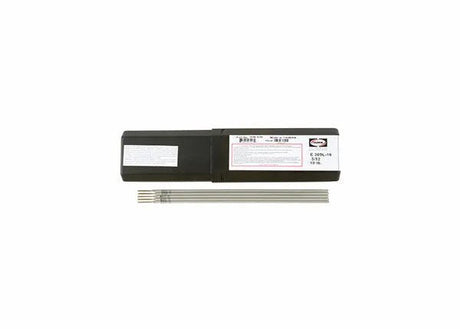
Harris 309L Stainless Stick SMAW Welding Rod
From $148.12$219.80Unit price /Unavailable
Lincoln Excalibur 309L Stick SMAW Welding Rod
From $122.16$191.76Unit price /Unavailable
309L Welding Rods Dissimilar Stainless Steel Electrodes
E309L welding rods are the electrodes used for welding stainless steel to carbon steel, the dissimilar metals joint in piping. The overalloyed composition, 23-25% chromium and 12-14% nickel, keeps weld metal austenitic. When severe corrosion conditions exist, these electrodes deliver increased resistance. Low carbon content (0.04% max) limits carbide precipitation and resistance to intergranular corrosion after welding.
When to Use 309L Electrodes
309L electrodes are used for welding when one side of the joint is ferrous base metal, and for welding similar alloys in the 309/310-series heat-resistant stainless steel range. Customers joining stainless to carbon steel or low alloy steel should understand that 308L lacks the alloy reserve required for dissimilar metal welding; 309L wire handles dilution. For joining dissimilar steels where severe corrosion conditions exist, 309L is generally the first-pass buffer.
For 304-to-304 similar alloys joints, 308L welding rods are correct. The full range is held in the stainless steel welding rods collection; 316L welding rods cover molybdenum-bearing applications.
309 vs 309L Welding Rod: Which Do You Need?
The "L" in 309L stands for low carbon. Standard 309 electrodes allow up to 0.12% carbon, while 309L caps carbon at 0.04% max. Both deposit weld metal at roughly 24% chromium and 13% nickel, so corrosion resistance and high-temperature service capability (up to about 870°C / 1600°F) are similar. The distinction matters when the weldment will see service in the carbide-precipitation range (roughly 800-1500°F) or in corrosive environments:
- Choose 309L for dissimilar metal joints, multi-pass welds, repair/maintenance on equipment, and any application where the part will not be solution-annealed after welding. 309L resists intergranular corrosion without post-weld heat treatment.
- Choose 309 for single-pass welds on heavy plate where higher tensile strength is needed and the joint will either be solution-annealed or run continuously above the carbide-precipitation range. 309 also tolerates higher dilution on thick-section dissimilar joints.
For most shop fabrication, repair, and pipe work, 309L is the safer specification because it eliminates the sensitization risk. Buyers searching for 309 welding rod for stainless-to-carbon joints almost always want 309L.
Carbon Content and Carbide Precipitation in 309L
The 0.04% maximum carbon content prevents carbide precipitation along grain boundaries. When carbon content is higher, chromium carbides deplete the protective matrix, creating zones where severe corrosion conditions accelerate failure. Low carbon content yields maximum ductility in the weld metal deposit. In wrought or cast form 309-series base metals, 309L electrodes provide increased resistance to sensitization and are used for welding wherever corrosion tests apply. Working with wrought or cast form components alongside low alloy steel flanges makes this carbon limit essential.
Stainless Steel to Carbon Steel: Welding Current Setup
E309L electrodes run on DC+ (DCEP) welding current. The -16 and -17 suffix variants add AC current for a basic welding machine. Welding current ranges:
- 3/32 in (3 32): 40-60 A for thin-gauge dissimilar metals welding
- 1/8 in (1 8): 55-85 A; ideal for stainless steel-to-ferrous joints; all-position with -15 and -16 products
- 5/32 in: 80-120 A for heavier plate; 1/8 in covers lighter items
Interpass temperature should be held below 300°F. Service temperature for the finished weldment can reach approximately 700°F (370°C) in continuous service for dissimilar joints, with high-temperature service capability up to 870°C (1600°F) for similar 309-series joints. Post-weld heat treatment should only be performed after due consideration of the base-metal pairing.
Typical Mechanical Properties (As Welded)
309L weld metal deposited from E309L-16 covered electrodes typically meets or exceeds these values:
- Tensile strength: 87,000-88,000 psi (600 MPa)
- Yield strength: 59,000-65,000 psi (407-450 MPa)
- Elongation in 2 in: 37-40%
- Typical chemistry: 0.04% max C, 23-25% Cr, 12-14% Ni, 1.0-2.5% Mn, 0.20-0.65% Si
- Coating: titania type (-16) for smooth arc and easy slag removal
These values conform to ANSI/AWS A5.4 / ASME SFA 5.4 specifications for E309L-16 stainless steel covered electrodes.
Dissimilar Metals: Joining Dissimilar Steels in Wrought or Cast Form
309L electrodes are used for welding: 304/304L stainless to A36 structural plate; stainless to low alloy steel in pressure vessels; 309/310-series stainless to ferrous headers in wrought or cast form.
To weld steels on the ferrous side, direct the electrode toward the stainless side. Contamination occasionally accelerates weld metal degradation. Tips before welding: verify current type and confirm 1/8 in diameter suits the joint. A video on welding technique is available on product pages for customers who want to understand the process.
Products and Stock
This collection holds 17 SKUs from Lincoln Electric and Harris, 1/16 in through 5/32 in. The Lincoln ED033097 Excalibur 309/309L-16 in 3 32 x 12 in cans and the Harris 309L-16 in 1 8 x 14 in box are held for immediate shipment. The 1/8 in item is the most frequently ordered item. Login to check per-pound pricing. Each product listing includes the AWS classification, current type, and position rating. Customers can test each item before committing to full box quantities.
309L Welding Rods Dissimilar Stainless Steel Electrodes
E309L welding rods are the electrodes used for welding stainless steel to carbon steel, the dissimilar metals joint in piping. The overalloyed composition, 23-25% chromium and 12-14% nickel, keeps weld metal austenitic. When severe corrosion conditions exist, these electrodes deliver increased resistance. Low carbon content (0.04% max) limits carbide precipitation and resistance to intergranular corrosion after welding.
When to Use 309L Electrodes
309L electrodes are used for welding when one side of the joint is ferrous base metal, and for welding similar alloys in the 309/310-series heat-resistant stainless steel range. Customers joining stainless to carbon steel or low alloy steel should understand that 308L lacks the alloy reserve required for dissimilar metal welding; 309L wire handles dilution. For joining dissimilar steels where severe corrosion conditions exist, 309L is generally the first-pass buffer.
For 304-to-304 similar alloys joints, 308L welding rods are correct. The full range is held in the stainless steel welding rods collection; 316L welding rods cover molybdenum-bearing applications.
Carbon Content and Carbide Precipitation in 309L
The 0.04% maximum carbon content prevents carbide precipitation along grain boundaries. When carbon content is higher, chromium carbides deplete the protective matrix, creating zones where severe corrosion conditions accelerate failure. Low carbon content yields maximum ductility in the weld metal deposit. In wrought or cast form 309-series base metals, 309L electrodes provide increased resistance to sensitization and are used for welding wherever corrosion tests apply. Working with wrought or cast form components alongside low alloy steel flanges makes this carbon limit essential.
Stainless Steel to Carbon Steel: Welding Current Setup
E309L electrodes run on DC+ (DCEP) welding current. The -16 and -17 suffix variants add AC current for a basic welding machine. Welding current ranges:
- 3/32 in (3 32): 40-60 A for thin-gauge dissimilar metals welding
- 1/8 in (1 8): 55-85 A; ideal for stainless steel-to-ferrous joints; all-position with -15 and -16 products
- 5/32 in: 80-120 A for heavier plate; 1/8 in covers lighter items
Interpass temperature should be held below 300 degrees F.
Dissimilar Metals: Joining Dissimilar Steels in Wrought or Cast Form
309L electrodes are used for welding: 304/304L stainless to A36 structural plate; stainless to low alloy steel in pressure vessels; 309/310-series stainless to ferrous headers in wrought or cast form.
To weld steels on the ferrous side, direct the electrode toward the stainless side. Contamination occasionally accelerates weld metal degradation. Tips before welding: verify current type and confirm 1/8 in diameter suits the joint. A video on welding technique is available on product pages for customers who want to understand the process.
Products and Stock
This collection holds 17 SKUs from Lincoln Electric and Harris, 1/16 in through 5/32 in. The Lincoln ED033097 Excalibur 309/309L-16 in 3 32 x 12 in cans and the Harris 309L-16 in 1 8 x 14 in box are held for immediate shipment. The 1/8 in item is the most frequently ordered item. Login to check per-pound pricing. Each product listing includes the AWS classification, current type, and position rating. Customers can test each item before committing to full box quantities.
FAQ: 309L Welding Rods
What is 309L used for?
E309L is used for welding stainless steel to carbon steel and low alloy steel, and for welding similar alloys in the 309/310-series stainless steel range. Joining stainless steels to dissimilar base metals in wrought or cast form is the primary application.
What welding current do 309L electrodes use?
DC+ (DCEP) current is standard. The -16 and -17 variants are rated for AC current and work on a basic welding machine. Check the product data sheet for the item. Joining hard dissimilar joints occasionally calls for a -16 type product.


