
E308L is the standard SMAW electrode for welding 304 and 304L stainless steel — the most widely used austenitic stainless grade in fabrication. The low-carbon designation (0.04% C max) prevents sensitization in the heat-affected zone, which is the mechanism by which welded stainless becomes vulnerable to intergranular corrosion at service temperatures. If your base metal is 304, 304L, or another 18-8 austenitic stainless, E308L is the rod your procedure specifies. Lincoln Electric Excalibur 308L is available in 3/32", 1/8", and 5/32" diameters in moisture-resistant (MR) packaging.
-

Lincoln Excalibur 308L Stick SMAW Welding Rod
From $118.15$131.04Unit price /Unavailable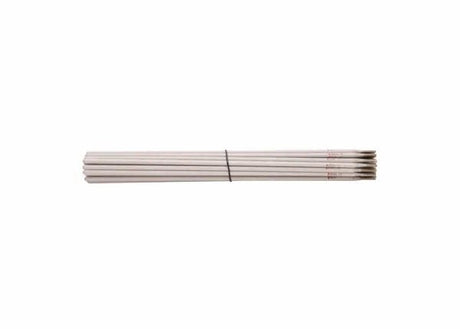
Harris 308L Stainless Stick SMAW Welding Rod
From $120.12$178.80Unit price /Unavailable
← All Stick Electrodes & Welding Rods
The E308L is the standard SMAW electrode for welding 304 and 304L stainless steel — the most widely used austenitic stainless grade in fabrication. The low-carbon designation (0.04% C max) is not a minor detail: it prevents sensitization in the heat-affected zone, the mechanism by which welded stainless steel becomes vulnerable to intergranular corrosion at service temperatures. If your base metal is 304, 304L, or another 18-8 austenitic stainless, E308L is the electrode your procedure calls for, and it is the grade that dominates stainless SMAW in production environments globally.
Choosing a 308L rod for your job
- Amperage range: 40–65 A for 3/32 in diameter; 60–90 A for 1/8 in; 90–130 A for 5/32 in. Always run stainless electrodes at the low end of the range to minimize heat input and limit heat-affected zone width.
- Polarity: DC+ (DCEP). The -16 and -17 suffix variants also run on AC for shops without DC-capable machines.
- Joint position: 308L-15 (lime flux) and 308L-16 (titania flux) are all-position. 308L-17 is preferred for flat and horizontal beads where a flatter, wider profile and lower silicon content are desired.
- Base metal: 304, 304L, and other 18-8 austenitic stainless steels. Also suitable for 301, 302, 321, and 347 when a non-stabilized deposit is acceptable per the applicable code or engineering specification.
- Typical applications: Food processing equipment, kitchen and commercial cooking equipment, pharmaceutical piping, architectural stainless work, and general fabrication of 304-series components where surface quality and corrosion resistance matter.
308 vs 308L Welding Rod: Which Do You Need?
The "L" in 308L stands for low carbon. Standard 308 (E308-16) allows up to 0.08% carbon, while 308L (E308L-16) caps carbon at 0.04% max. Both deposit weld metal at roughly 19-21% chromium and 9-11% nickel — so corrosion resistance and high-temperature service capability are essentially equivalent. The carbon difference matters when the weldment will see service in the carbide-precipitation range (roughly 800-1500°F):
- Choose 308L for multi-pass welds on 304/304L, food and pharmaceutical work, repair, and any application where the part will not receive post-weld solution annealing. 308L resists intergranular corrosion without heat treatment, which is why it dominates production stainless SMAW.
- Choose 308 only for single-pass welds on heavy section where higher carbon content yields slightly better tensile strength and the joint will either be solution-annealed or operate above the sensitization range. In modern shop practice, 308L is the default specification.
Buyers searching for 308 welding rod for stainless fabrication almost always want 308L. ER308L TIG rod (referenced in welding procedure specifications) uses the same chemistry in bare-wire form for GTAW root passes and thin-section work — covered in the stainless TIG rods collection.
Typical Mechanical Properties and Chemistry (As Welded)
E308L-16 weld metal deposited from covered electrodes typically meets or exceeds these values:
- Tensile strength: 80,000–84,000 psi (550–580 MPa)
- Yield strength: 58,000–64,000 psi (400–440 MPa)
- Elongation in 2 in: 40–46%
- AWS specification minimum: 75,000 psi tensile, 35% elongation
- Typical chemistry: 0.04% max C, 19.0–21.0% Cr, 9.0–11.0% Ni, 0.5–2.5% Mn, 0.90% max Si
- Coating: titania type (-16) for smooth arc, all-position capability, and easy slag removal; lime type (-15) for higher-purity weld metal in critical applications
These values conform to ANSI/AWS A5.4 / ASME SFA 5.4 specifications for E308L-16 stainless steel covered electrodes. The 19–21% chromium and 9–11% nickel produce a fully austenitic weld metal with the same general corrosion resistance as the 304 base material.
Sensitization and Why Low Carbon Matters
When carbon content exceeds about 0.05% in austenitic stainless weld metal, chromium carbides precipitate along grain boundaries during cooling through the 800-1500°F range. This depletes the surrounding matrix of chromium, leaving narrow zones with insufficient chromium to maintain the passive oxide film. The result is intergranular corrosion at the weld — a failure mode that often appears months or years after the part enters service. E308L's 0.04% maximum carbon eliminates this risk without post-weld solution annealing. For 304 base metal in food, pharmaceutical, architectural, or any wet/corrosive service, E308L is the safe specification; the cost difference over standard 308 is negligible compared to the cost of a failed weld.
What's in this collection
This collection holds 26 active SKUs of E308L electrodes from Lincoln Electric and Harris, covering diameters from 3/32 in through 3/16 in in both 8 lb and 10 lb packages. Representative products include the Lincoln ED033079 Excalibur 308L-16 in 3/32 x 12 in (8 lb easy-open can) — a rutile-flux all-position electrode with outstanding slag removal and bead appearance — and the Harris 308L-16 in 1/8 x 14 in (10 lb box), a proven production option where Harris product approval is required. The Excalibur moisture-resistant can packaging helps maintain electrode condition between uses in high-throughput shops.
If you're joining 304 stainless to carbon steel or low-alloy steel, switch to the 309L welding rods, which are specifically formulated to handle dilution from carbon-steel base metal. For chloride or pitting service on molybdenum-bearing 316/316L stainless, use 316L welding rods instead. For a broader selection across all stainless AWS classes, the stainless steel welding rods collection covers every grade WeldingMart carries. The digit and suffix system used in the 308L classification is explained in detail in the AWS classification guide.
Welding Practice and Technique
Weld technique matters as much as electrode selection for 308L. Use stringer beads over weaves, keep interpass temperature below 350°F, and avoid excessive restrike on the same location. On thin-gauge material, a short-arc technique helps prevent warping. Joint cleaning is essential — oil, scale, and surface oxides must be removed before welding. Even small amounts of carbon contamination from the wrong grinding wheel can locally compromise corrosion resistance in the heat-affected zone and at the fusion boundary. Use a dedicated stainless-only flap disc or wire brush; carbon-steel abrasives transfer iron particles that rust and create crevice-corrosion sites.


